

Table of contents:
Lately we have been eating a lot of strawberries and redcurrants from the vegetable garden, with apples and pears soon to follow. In our chicken run there are 2 dwarf fruit trees, an apple tree and a pear tree. Perfect, because my vegetable garden is not very big. Moreover, fruit trees are also suitable for small gardens. Growing fruit is actually not nearly as difficult as you might think. How do you go about it exactly? I will explain everything to you in this article. That way, planting a fruit tree becomes child's play. Growing fruit does not just provide a nice harvest. In the spring, you can enjoy the beautiful blooming period and bees buzzing from one blossom to the next. Here we go!
'an apple a day keeps the doctor away', especially if you have grown it yourself
The different types of fruit trees
TIP 1: choose the right type of fruit tree to plant based on the size of your vegetable garden
Anyone can grow fruit. You do not need a gigantic vegetable garden for it. The most important thing is to choose a fruit tree that 'fits' in your vegetable garden. There are 5 different types in which fruit trees are offered. To get an idea of how big your fruit tree will get, look at the terms patio tree, columnar tree, dwarf tree, half-standard, and standard. These terms refer to the type of rootstock used for grafting. Just like with grapes, fruit trees are grafted at the nursery because it is known that non-grafted fruit trees often do not root as well. Consequently, they grow less strongly and produce less of a harvest. Just like us, you naturally want strong fruit trees that bear kilos of fruit. That is why we only offer grafted fruit trees on the webshop. I will now explain exactly what the terms patio tree, columnar tree, dwarf tree, half-standard, and standard mean.

Mini plum tree
Patio trees
Patio trees are also called ballerina or miniature fruit trees. That is because the trees, well, what did you expect, stay very small. They reach about 1.5 meters in height. Perfect for growing in a pot (for example on your terrace or balcony) and require little maintenance. Keep it small by pruning occasionally. This tree may be small, but the fruits are just as large as those from a dwarf fruit tree. Just make sure to give the fruit trees enough water. If your tree has been dry, it will be the first thing to drop its fruit. What a waste! If you choose to plant your fruit tree in open ground, give it extra water in the year of planting, especially in the summer or on hot days. Later, I will provide tips on how and where best to plant a tree.

Columnar (apple) trees grow vertically and produce few side branches
Columnar trees
A columnar tree is a fruit tree that grows vertically and produces hardly any side branches. As a result, a columnar tree takes up very little space. It is ideal for growing fruit in smaller areas or in a (40-liter) pot. Because a columnar tree produces few to no side branches, pruning is not necessary. Do you have an empty spot next to your garden shed? This type of fruit tree is ideal for making the most of small spaces.

Dwarf Conference pear tree
Dwarf fruit trees
Dwarf fruit trees mean that the tree is grafted onto a slow-growing rootstock, which allows the trees to bear fruit faster and grow less tall. The advantages of this are that they are suitable for smaller (vegetable) gardens and that you can therefore grow more varieties in the same space. A dwarf fruit tree reaches approximately 2.5 meters to 4 meters in height, which is why you should leave 2.5 to 4 meters between each dwarf fruit tree. It is important to leave enough space between the trees so that they can grow well and develop optimally. That is convenient because it allows you to harvest easily, safely, and without a long ladder. Dwarf fruit trees therefore do not take up a lot of space. Ideal for everyone (including myself ?) who feels that their vegetable garden is too small for everything they want to grow. Dwarf fruit trees live for about 40 years. We offer many different types of fruit trees in our webshop. Definitely take a look; there are some very nice varieties available. Above all, choose fruit that you personally enjoy. Because the fact that these fruit trees are dwarfs does not mean you will have a smaller harvest. You can count on a harvest of between 5 and 20 kg of fruit. Ideal for being able to grow plenty of fruit despite perhaps having a small vegetable garden.
Semi-dwarf fruit trees
Semi-dwarf fruit trees, like dwarf fruit trees, are grafted onto a slow-growing rootstock. Semi-dwarf fruit trees grow approximately 5 meters tall, which is why you should also leave 5 meters of planting distance between them. For this type of fruit tree, you will need to provide a bit more space than for dwarf fruit trees. A semi-dwarf fruit tree can quickly provide 50 kg of fruit. They can live to be 60 to 100 years old.
Standard fruit trees
Standard fruit trees are, as their name suggests, the tallest variety. They can reach 7 to as much as 8 meters in height. The recommended planting distance is once again the estimated height: 7 to 8 meters. For these fruit trees, you need a fairly large garden (or orchard). The rootstock of a standard fruit tree is at least 1.7 m, which is why we do not offer this type of fruit tree.
Planting a fruit tree
And now for the real work. After figuring out which type of fruit trees are suitable for your vegetable garden and choosing the fruit variety/varieties you will be growing, you are going to plant your fruit trees. When planting trees, it is important to pay attention to proper preparation and planting technique so that the trees can grow well and provide an optimal yield. I will now explain how best to go about that.
TIP 2: keep in mind that fruit trees grow old
When planting fruit trees, you have to think a bit more about the future than when laying out your vegetable garden. Most vegetables stay in your vegetable garden for only one or two seasons, while most fruit trees can live for 30, 40, or even 100 years. The lifespan of fruit trees naturally also depends somewhat on their care and size. The older a tree can get, the larger it grows.
TIP 3: do you want a lot of fruit? Then plant more than one fruit tree of the same species and increase your harvest that way

By allowing cross-pollination to take place, you play it safe
What, cross-pollination? Cross-pollination of fruit trees takes place during the flowering season, where pollen from the male part of the flower is transferred to the female part. Transferring pollen from one fruit tree to another fruit tree is called cross-pollination. Therefore, it is a good idea to plant 2 different varieties of the same fruit type so that insects find enough blossoms and can transfer the pollen from one tree to another. Cross-pollination can only take place between the same type of fruit tree; for example, a pear tree cannot pollinate a cherry tree. For each type of fruit tree, we have provided a large number of classic as well as special varieties. For example, we have 8 apple varieties available in the webshop :)
When is the best time to plant your fruit tree?
TIP 4: you can actually plant out fruit trees almost all year round
The fruit trees we offer in our webshop are delivered in pots. They have already developed a root system, which means you can actually plant them out all year round. The best planting period is in the autumn. It is no longer as hot, it still rains occasionally, and the fruit trees have enough time to take root. This allows them to enter the winter with a solid root system and sprout for the first time in the spring, and perhaps bear their first fruits a few months later. But watch out! Never plant fruit trees during frost. Sometimes fruit trees are also offered with bare roots. We at Plukkers do not do that. For the simple reason that the roots would quickly dry out on the way, giving your tree a bad start.
How do you plant a fruit tree?
Good preparation is essential for a successful tree planting in open ground. Start by choosing a suitable spot and dig a spacious planting hole that is large enough for the tree's roots. You can mix the excavated soil with compost or other organic materials to improve the soil structure. This ensures that the soil is loose and nutritious, which promotes root development. Note: Do not use fresh compost or stable manure. Worm compost is the best thing you can use.
When planting a tree, it is important to pay attention to the type of roots. Balled trees must be placed in the planting hole with the root ball intact, while bare-root trees should have their roots carefully spread out in the hole. Make sure the roots have enough space and are not bunched up.
Fill the planting hole with the improved excavated soil and press the earth down lightly. After planting, it is important to give the tree plenty of water with a full bucket of water. This helps the soil settle around the roots and prevents air pockets.
By following these steps, you give your fruit trees the best start and increase the chance of healthy growth.
TIP 5: ensure loose soil that contains sufficient structure
Regardless of the type of fruit tree you choose (mini fruit tree, columnar tree, dwarf, semi-dwarf, or standard), the planting remains the same. Loosen the soil well using a spade, and ensure good soil structure by adding worm compost, lava grit, basalt meal (and if growing on sandy soil) bentonite. Dig a hole about half a meter in diameter and make a planting hole that is slightly deeper than your plant pot. Catch the soil in a bucket and mix in 1/3 coconut fiber or compost. This ensures that the soil has a better structure, moisture is retained better, and the little tree can take root easily. Always place your tree at the same depth as it was at the nursery (the depth of the pot).
Planting distance
The distance between fruit trees is the same as the estimated size of your fruit tree. If you choose patio fruit trees, keep a distance of 1 to 1.5 meters; for dwarf fruit trees, 2.5 to 4 meters; for semi-dwarf fruit trees, keep 5 meters of distance, and so on... Columnar fruit trees are an exception; you may plant those closer together. Because columnar trees hardly produce side branches, a planting distance of 0.5 meters is sufficient.
Provide support for your fruit tree
After you have planted your fruit tree, it is important to support it. A support stake is essential for young trees to prevent them from growing crooked or getting damaged by the wind. I use a chestnut stake and a tree tie for this. You can also use multiple stakes for extra stability, especially with larger trees or in windy locations. Place the support stake on the side of the prevailing wind direction, for example, southwest in relation to your fruit tree, so that the tree is protected from the wind and does not keep blowing against the stake. This prevents the trunk from rubbing and getting damaged. Hammer your stake about 40 cm into the ground. Secure the tree firmly to the stake with a tree tie at a height of about 30-40 cm, so that the tree stays upright and the trunk is protected from damage.
In this video, Tom shows his selection of fruit trees:
TIP 6: fruit trees can also be grown in pots
There is nothing better than fruit from your own garden. But what if you live in an apartment or your garden isn't very large? That doesn't mean you can't grow fruit. You can perfectly grow patio or mini fruit trees in pots. You can also grow Dwarf fruit trees in pots. Make sure your pot is large enough; about 40 liters is sufficient. Growing in a pot does require some extra attention. If you let the potting soil dry out, your fruit tree will drop its blossoms or fruit. And then it's game over, of course. Therefore, choose potting soil that has good structure. To ensure your potting soil dries out less quickly, you can place about 3 cm of hydro-pellets at the bottom and create your own mixture to fill your pot. To do this, mix 1/3 coconut fiber with 2/3 potting soil. This ensures that water is retained longer. A second point of attention is nutrition, which becomes depleted about 3 months after planting. That 'problem' is also easy to tackle. Sprinkle some fertilizer for small fruit in your pot every 3 months (but not between October and March, as your tree is dormant then). When watering, the fertilizers gradually dissolve. This way, your little tree always gets what it needs to grow well.
TIP 7: choose a special variety
My children love fruit, and that's a good thing. In all kinds of forms: juices, jam, snacking on an apple slice in their hand, ... delicious. However, they don't just eat cherries, apples, and pears. They also love mandarin oranges (satsumas are those delicious pale yellow mandarins), persimmons, peaches, ... Varieties that I thought I would never be able to grow myself.
But Plukkers wouldn't be Plukkers if we didn't go looking for varieties (usually organic) that grow well in our climate and are often also resistant to diseases.
For the first year, I have mini pomegranates, satsuma mandarins, blood oranges, yuzu, and Meyer lemons. The first mandarin brought tears to my eyes, not just from the fine acidity of the fruit.
This winter, I am going to plant a number of imaginative varieties. An almond tree is on the schedule, for example. Together with the walnuts and hazelnut, they should reduce my spending at the nut shop :). I am also going to plant an apricot tree and a persimmon tree. You can never have too much fresh fruit as a family. By the way, raspberries are also highly recommended to plant as small fruit; they are easy to maintain and produce results quickly.
I have listed a few trees below that are really worth trying. Please know that we cannot offer these trees all year round; if the tree is sold out, you can subscribe on the product page to stay informed about new stock.
Caring for fruit trees
By now, your little tree has grown well and you may have already been able to harvest your first apples or cherries. How do you ensure that you can continue to enjoy your fruit tree for years to come?
TIP 8: give your fruit trees something delicious every now and then
To be able to eat delicious, flavorful fruit yourself, your fruit tree requires nutrient-rich soil. Give your fruit tree some fertilizer for small fruit and strawberries every 3 months. This is a balanced fertilizer that has everything your fruit tree needs. Do not give fertilizer when your fruit tree is dormant (from October to March).
Pruning fruit trees, how do you do it?
It is best to prune fruit trees twice a year. With the exception of patio trees and columnar trees. You prune patio trees to maintain their small shape. Columnar trees, on the other hand, do not need pruning at all, unless a large side branch should grow, in which case you can snip it off.
Tip 9: It is best to prune low-stem fruit trees twice a year
By pruning your fruit trees, you ensure that the energy is directed to the right place in your tree, thereby stimulating growth. Fruits always grow on scaffold branches. A scaffold branch is a primary branch that grows from the main trunk. Aim for 5 or 6 scaffold branches. Side branches will grow from these, which will bear your fruit. There are 2 types of pruning: summer pruning and winter pruning. Always prune just above a bud so your fruit tree can easily grow again. Look for an outward-facing bud, which is a bud on the outside of the branch. This will ensure that the branch grows outward, which is exactly what you need.

Winter pruning: look at your fruit trees from a distance
Winter pruning (between December and mid-February)
In the summer, your fruit tree has grown vigorously. It has managed to produce beautiful branches where your first or new fruits will appear next year. Look at your fruit tree from a distance. Do you see branches growing quickly and straight up? That is a water sprout. You can prune these branches back significantly during winter pruning, leaving 1 or 2 buds per branch. Do you see branches growing inward? You should prune these away as well. They cause your fruit tree to be less airy and prevent sun from reaching your leaves and fruits.
Summer pruning (between mid-April and September)
In the summer, you prune your fruit trees because the energy is directed towards your fruits. If you prune your fruit tree, your fruits will grow and ripen better. As you know, a fruit tree, just like all other plants in your vegetable garden, performs photosynthesis. Therefore, do not remove all the leaves. Nut trees and fruit trees that bear stone fruit (peach, plum, apricot, and cherry) are the exception; only prune these in the months of December-January. Otherwise, they lose too much sap and can "bleed" to death.
Use proper and clean pruning tools
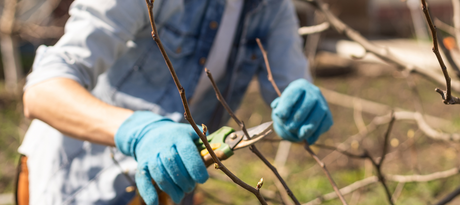
To ensure that pruning goes smoothly, it is best to use a decent pruning shear. Do you have larger branches that need to be removed? Use loppers instead.

Tip 10: Growing fruit trees in espalier form
Apples and pears are often planted as espalier trees, which is ideal for people with limited space. Espalier trees can also be trained perfectly against a wall, allowing them to benefit from extra warmth and support.
A fruit tree in espalier form is not only practical but also beautiful to look at. You start with a young tree with a straight trunk and flexible side branches, for example, an apple or pear tree on M9 or M26 rootstock. Plant the tree in fertile, well-draining soil in a sunny spot.
Immediately place a sturdy espalier frame or stretched horizontal wires against a wall or free-standing. You tie the bottom branches horizontally to the bottom wire, with subsequent tiers growing above them. Ensure you prune annually: structural pruning in the winter for shape, and in the summer to slow growth and stimulate fruit production.
Use tying material that doesn't cut, such as Vigne-Fix, rubber bands, or a tying tool. Regularly check that the branches are still securely attached but not being constricted. Fertilize in the spring and water during dry periods.
Espalier trees take up little space, provide plenty of fruit, and fit perfectly in small gardens or against facades. You get an elegant, productive, and easy-to-maintain system – provided you keep pruning and training annually. This way, with patience and attention, you can build a beautiful espalier tree.
In conclusion
Hopefully, I have been able to convince you with these tips to start growing fruit in your own garden. With these tips, you will surely succeed. Enjoy the beautiful flowering period in the spring and the delicious fruits in the summer or autumn. If you found this article valuable and are considering growing fruit yourself, consider purchasing your garden supplies in our webshop. We are always ready to help with good quality, a kind explanation (via phone, chat, or email); your gardening success is our priority. Photos from your vegetable or fruit garden are always welcome at support@plukkers.com.
Frequently asked questions about planting fruit trees:
1. What is the best time to plant fruit trees?
The best period to plant a fruit tree is from November to March, as long as it isn't freezing. During this dormant period, the roots can establish themselves well. Choose bare-root trees in late autumn or early winter, or pot-grown trees in the spring.
2. What is the easiest fruit tree?
An apple tree, pear tree, or plum tree is a good choice if you are planting a fruit tree for the first time. Above all, choose a fruit tree that fits the space you have. For a small garden, a low-stem fruit tree, columnar tree, or patio tree is ideal. Patio trees remain compact and require little maintenance, while columnar trees barely grow side branches and require little pruning.
3. Which fruit trees are hardy?
Many apple trees, pear trees, plum trees, and cherry trees are hardy and suitable for our climate. Pay attention to the characteristics of the specific variety. Some unusual fruit species can be more sensitive to severe frost or late night frosts. A fruit tree in a pot is also more vulnerable to frost than a tree planted in open ground.
4. Which fruit trees can be planted together?
Different fruit trees can easily stand next to each other. For pollination, it is particularly interesting to plant two different varieties of the same fruit type together. Two compatible apple varieties can pollinate each other, for instance, but a pear tree cannot pollinate an apple or cherry tree. By combining suitable varieties with overlapping flowering periods, you increase the chance of successful pollination and harvest.
5. How deep do you plant a fruit tree?
Plant the tree so that the graft union (the swelling on the trunk) remains just above the ground. Do not plant the tree too deep: the root collar must be level with the ground surface. Planting too deep can cause growth problems.
6. Can you still plant trees in November?
Yes, November is actually an excellent month to plant a fruit tree. The fruit trees from Plukkers are delivered in pots and can therefore be planted almost year-round. Autumn is an ideal planting period because it is less hot and the tree has time to root properly. Just do not plant a fruit tree when the ground is frozen.
7. How many meters apart should fruit trees be?
The correct planting distance depends on the type of fruit tree. For patio trees, you can maintain about 1 to 1.5 meters. Low-stem fruit trees are planted about 2.5 to 4 meters apart, and for half-standard fruit trees, you should allow about 5 meters. High-standards need about 7 to 8 meters. Columnar fruit trees can be planted much closer together: about 50 centimeters is sufficient because they form almost no side branches.
8. How often should you water a fruit tree?
Water regularly in the first 2 years, especially in dry periods. You should water a fruit tree 1–2 times per week in the summer, with about 10–20 liters at a time. Deep watering stimulates strong root growth.
9. Which fruit tree is suitable for a small garden?
For small gardens, it is best to choose a patio tree, columnar tree, or espalier fruit tree, such as apple, pear, or plum on a dwarfing rootstock, or dwarf fruit trees as we call them. These trees remain compact, bear fruit early, and are easy to maintain.
10. When does a fruit tree first bear fruit?
A fruit tree usually produces its first harvest after 2 to 5 years, depending on the type of tree and the rootstock. Dwarf trees produce fruit sooner than standard (full-size) trees. Regular pruning and care promote early fruit set.




1 comment
Het grote geluk zit in de kleine dingen. Een vers gebakken brood of frambozen uit eigen tuin. Dit (geluk) is maakbaar en wij bieden daarvoor alle tools. Onthaast, vertraag, maak en pluk de vruchten.
Dank je wel! Ik ben het hier zó mee eens💕